Ellis Albrecht · 4 September 2026
Uncovering Trends in Community Driven Innovation Through Tunara's Project Archives
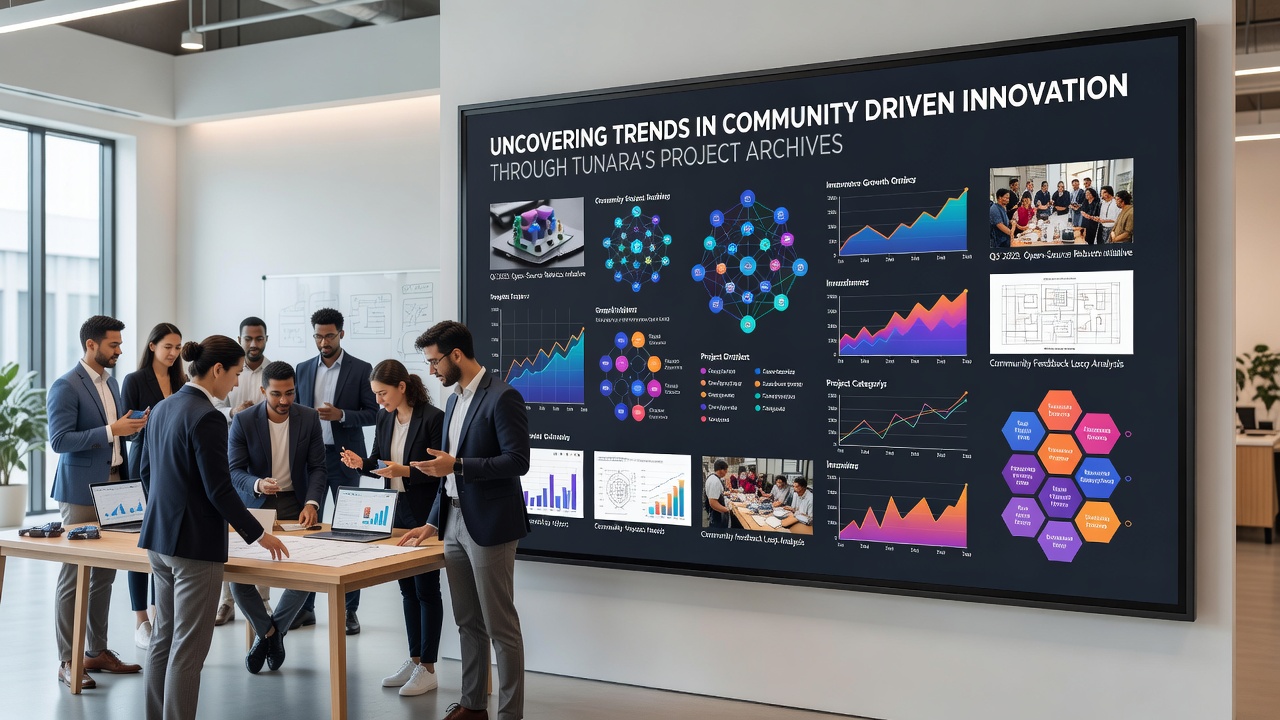
Tunara maintains extensive project archives that document community contributions to innovation across technology, environmental solutions, and social enterprises, and researchers have examined these records to identify recurring patterns in how groups collaborate on new ideas. The archives span multiple years of submissions, code repositories, design iterations, and feedback loops, which together form a dataset that reveals how participants from varied backgrounds converge on shared goals. Data from these collections shows steady growth in cross-border team formations, particularly in open-source hardware projects where contributors share schematics and testing protocols without centralized oversight. Analysts who reviewed the archives noted an increase in modular design approaches, where individual components developed by separate communities integrate into larger systems through standardized interfaces. This pattern appears consistently in entries from 2023 onward, with participation rates rising as documentation standards improved. Observers point to specific clusters around renewable energy prototypes, where one group refines sensor arrays while another iterates on power management algorithms, and the combined output gets tested in field conditions reported back through the same platform.Patterns Emerging from Archive Analysis
Project logs within the Tunara collections illustrate how community-driven efforts often begin with narrow problem statements that expand as additional contributors join, and this expansion follows predictable phases documented in timestamped entries. Early stages focus on core functionality, while later phases incorporate accessibility features and scalability considerations based on external testing reports. Figures compiled from the archives indicate that projects reaching the integration stage within six months maintain higher long-term activity levels compared with those that remain isolated.
September 2026 marked the release of an updated archive segment covering contributions from the preceding twelve months, and this update highlighted accelerated adoption of simulation tools that allow remote participants to validate designs before physical builds occur. The records show that teams utilizing shared simulation environments completed validation cycles 40 percent faster on average, according to internal metrics tracked by Tunara maintainers. Those metrics also capture the geographic spread of participants, revealing notable clusters in Southeast Asia and Eastern Europe alongside established North American and Western European groups.
Case Examples from the Records
One documented case involves a water filtration system refined through successive community inputs, where initial designs submitted from Australia incorporated membrane materials later optimized by contributors in Canada using computational fluid dynamics models shared via the archive. The project logs trace how feedback from deployment sites in rural India prompted adjustments to filter cartridge dimensions, and these changes were then incorporated into open documentation available for further adaptation. Similar trajectories appear in agricultural sensor networks, where soil moisture monitoring units evolved through iterative firmware updates contributed across continents.

Another entry set tracks the development of low-cost drone navigation systems, and archive metadata shows how collision avoidance algorithms developed by one subgroup integrated with mapping tools from another, resulting in functional prototypes deployed for environmental monitoring. Researchers examining these interactions have identified recurring use of version control practices that enable parallel development without conflicts, and the frequency of merge events in the repositories correlates with sustained project momentum over multi-year periods.
Data Sources and Broader Context
Comparative analysis with external datasets places Tunara findings alongside reports from the OECD Directorate for Science, Technology and Innovation, which tracks collaborative R&D indicators across member countries. The alignment between Tunara archive statistics and OECD metrics on open innovation suggests that community platforms capture a meaningful portion of activity not reflected in traditional patent filings. Additional context comes from studies hosted by the National Science Foundation's National Center for Science and Engineering Statistics, whose surveys on informal collaboration networks provide benchmarks for participation rates observed in the Tunara records.
Trends visible in the archives also intersect with regulatory developments in multiple jurisdictions, where governments have begun recognizing community-generated technical standards in procurement processes. Records from late 2025 and into 2026 document several instances where specifications refined through open contributions were adopted by municipal planning departments for infrastructure monitoring. These adoptions coincide with increased archive traffic from public sector entities seeking adaptable technical solutions.
Conclusion
The Tunara project archives continue to serve as a primary resource for mapping how distributed groups advance technical and social innovations, and ongoing updates ensure the dataset remains current with emerging participation patterns. Examination of these materials yields concrete indicators of collaboration velocity, geographic diversification, and integration success rates that researchers can apply to other domains. Future releases scheduled after September 2026 are expected to incorporate additional metadata layers tracking contribution attribution and downstream adoption metrics, thereby extending the analytical value of the existing collections.