
Carlo Lehmann · 18 September 2026
Tracing Collaboration Pathways in Platform Based Resource Sharing Networks
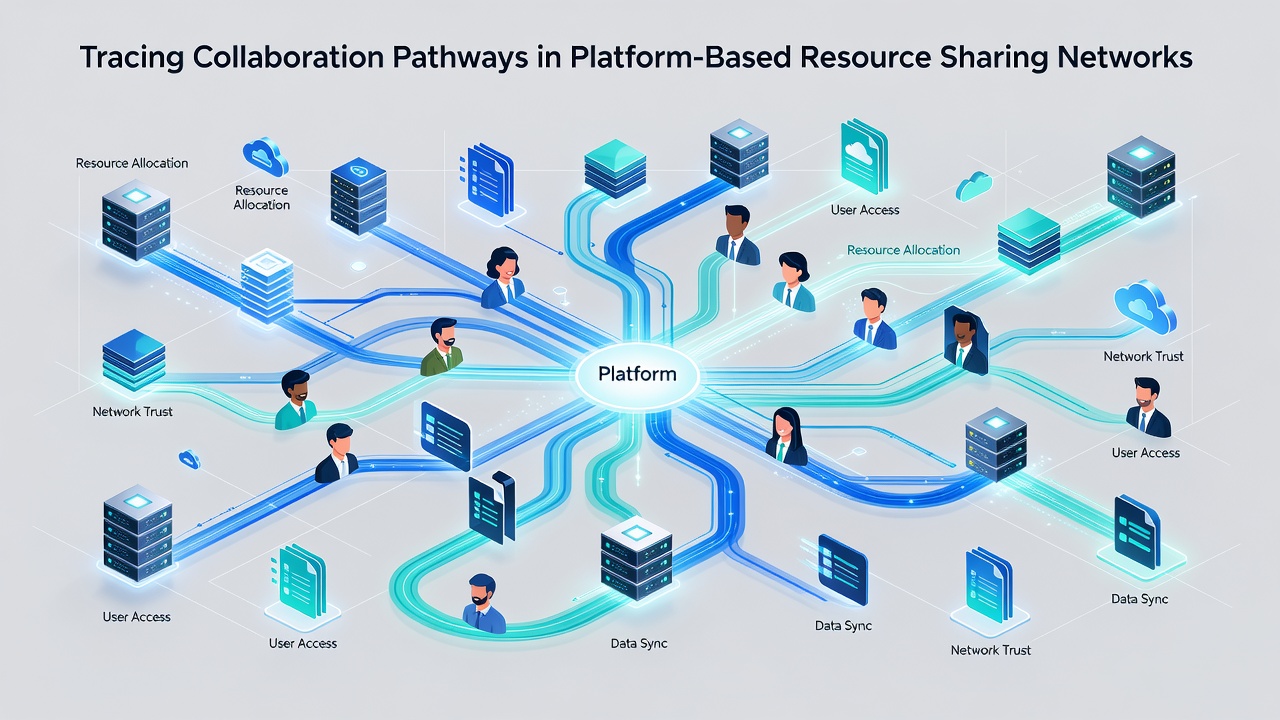
Platform based resource sharing networks connect participants who exchange tools, data sets, computing capacity, and physical assets through structured digital interfaces, and researchers track these exchanges by mapping the sequences of interactions that link contributors to recipients over time. Data from multiple studies shows that such networks have expanded rapidly since the mid 2010s, with transaction volumes increasing as platforms standardize APIs and verification protocols.
Observers note that tracing collaboration pathways requires recording both direct transfers and indirect influences, such as when one participant adopts a resource configuration suggested by another who remains several steps removed in the chain. Network analysis tools capture these patterns by logging timestamps, participant identifiers, and resource metadata, which allows reconstruction of pathways even when exchanges span multiple organizations.
Core Mechanisms of Pathway Formation
Participants initiate pathways through requests posted on platform dashboards, and algorithms match requests to available resources while logging the resulting connections. Once a match occurs, the system records the handoff details, including usage terms and return conditions, creating a traceable record that later analysis can aggregate across thousands of similar events. Studies conducted by European research consortia indicate that pathways often branch when shared resources are modified and reintroduced into the network by the initial recipient.
Platform operators maintain audit logs that include cryptographic signatures for each transfer, which prevents tampering and enables independent verification of collaboration sequences. Government agencies in several regions, including the United States Department of Commerce and the Australian Competition and Consumer Commission, have published guidelines that encourage platforms to retain these logs for at least five years to support regulatory oversight and academic inquiry.
Analytical Approaches Used by Researchers
Graph theory provides the primary framework for modeling these networks, where nodes represent participants and edges represent resource transfers. Centrality measures identify key intermediaries who facilitate disproportionate numbers of exchanges, while community detection algorithms reveal clusters that specialize in particular resource categories. One longitudinal project that examined European open data platforms between 2022 and 2025 found that pathways within specialized clusters exhibited shorter average lengths than those crossing cluster boundaries.
Researchers also apply temporal analysis to determine how pathway duration correlates with resource type and participant experience level. Shorter pathways tend to involve standardized digital assets such as code libraries, whereas physical asset sharing often generates longer sequences that include inspection, transport, and return stages. Data compiled by university teams in Canada and Singapore demonstrates that experienced participants reduce pathway length by reusing previously validated routes rather than exploring new connections each time.
Examples from Operational Platforms
Take the case of a European scientific computing grid that began publishing pathway statistics in quarterly reports; analysts observed that certain research groups consistently served as bridges between experimental facilities and data repositories, shortening the time required for other groups to access processed data sets. A separate initiative in North America focused on shared manufacturing equipment documented how small firms located pathways through a central booking system, enabling equipment utilization rates to rise without additional capital investment.
These operational examples illustrate that pathway tracing supports both operational improvements and policy evaluation. Platform administrators use the resulting maps to adjust matching algorithms, while external evaluators examine whether access remains equitable across geographic regions and organizational sizes. Reports released by the OECD in 2025 highlighted measurable differences in pathway density between urban and rural participants, prompting targeted outreach programs in several member countries.
Developments Anticipated by September 2026
Industry observers expect several platforms to release updated tracing dashboards that incorporate machine learning models capable of predicting likely continuation points along existing pathways. Pilot versions of these tools already appear in test environments, and full deployment is scheduled to coincide with an international symposium planned for September 2026 in Singapore. Concurrently, regulatory bodies in the European Union and Australia have signaled intentions to require standardized export formats for pathway data, which would facilitate cross platform comparisons.
Academic groups continue to refine methods for handling incomplete records, since some participants opt out of detailed logging for privacy reasons. Techniques that rely on aggregated flow statistics rather than individual identifiers have gained traction, preserving analytical value while reducing exposure of sensitive information.
Conclusion
Tracing collaboration pathways in platform based resource sharing networks yields structured records that support both day to day operations and longer term strategic decisions. The combination of graph based modeling, temporal sequencing, and standardized logging creates a factual foundation that multiple stakeholders can consult. As platforms prepare for the reporting enhancements expected by September 2026, the available data sets will grow in both volume and granularity, enabling more precise mapping of how resources move through these interconnected systems.